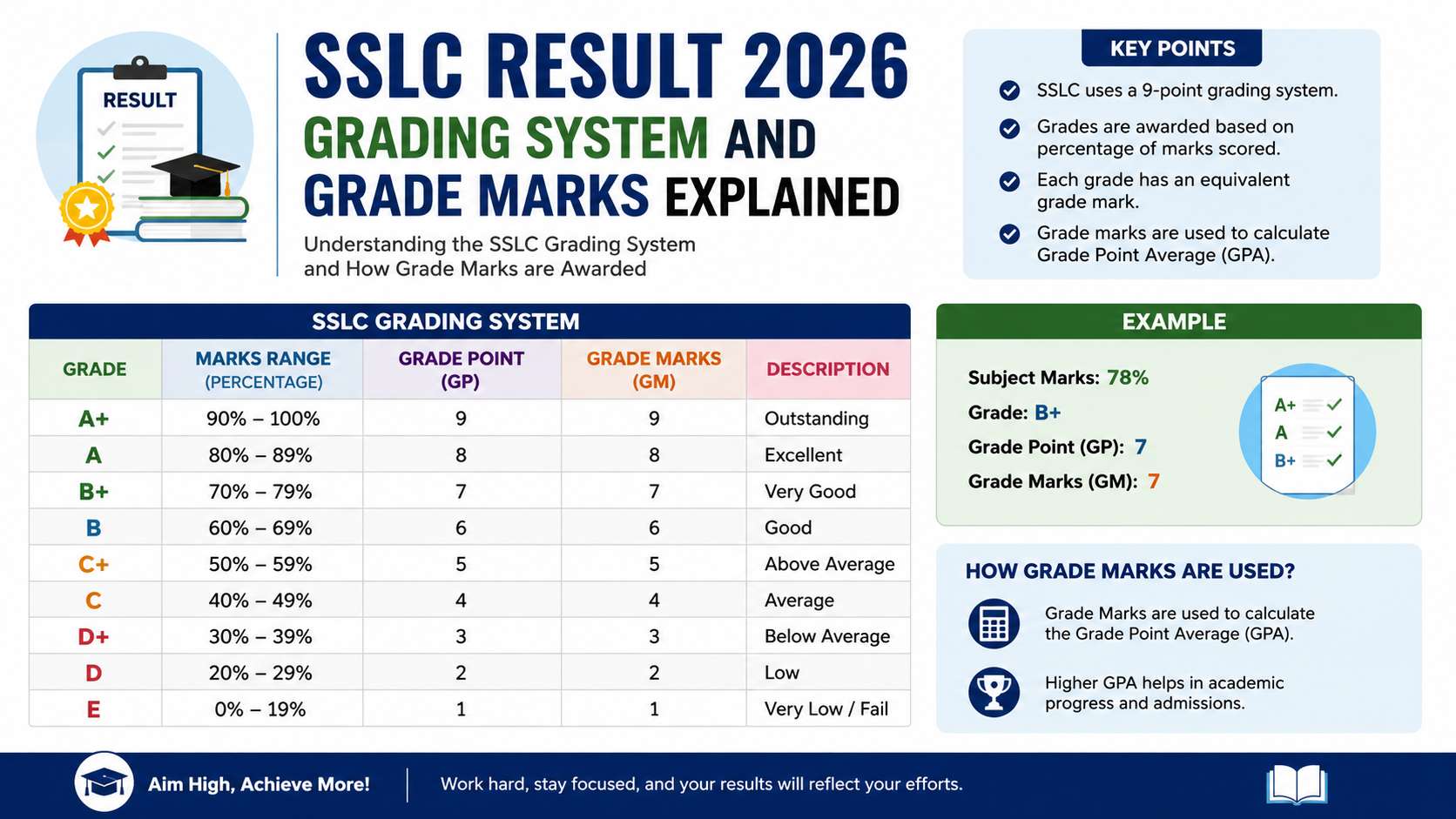
Searching for sslc result grade marks can be confusing because SSLC is not governed by one national grading system. Grade bands, pass rules and marks-card formats depend on the state board.
This guide explains the Karnataka SSLC framework, where the Karnataka School Examination and Assessment Board (KSEAB) released SSLC 2026 Exam-1 results on 23 April 2026 and the consolidated “best marks” result for Exam-1 and Exam-2 on 30 May 2026. It also clarifies an important 2026 policy issue: third-language marks were ultimately retained for the current examination cycle following a Karnataka High Court direction.
Key Takeaways
- Karnataka SSLC 2026 results use marks and subject grades; the standard passing grade begins at 35%.
- The familiar grade scale is A+ (90–100), A (80–89), B+ (70–79), B (60–69), C+ (50–59) and C (35–49).
- A proposed move to grade third-language papers separately was not applied to the 2026 examination cycle after a court ruling.
- Karnataka’s SSLC total remains relevant to the marks-card calculation for the 2026 cycle; do not assume a 525-mark aggregate from online rumours.
- Check Karnataka results only through the official Karnataka Examination Results portal; the online result is for immediate information and is not the original marks card.
- SSLC grading differs by state. A Kerala or Tamil Nadu SSLC result should be interpreted using that state board’s own official rules.
First, Know Which SSLC Board Issued Your Result
“SSLC” usually refers to the Class 10 Secondary School Leaving Certificate examination, but it is administered by different state authorities. Therefore, there is no single India-wide answer to questions such as “What marks are needed for A+?” or “How is SSLC percentage calculated?”
For example:
| State/board context | What students should rely on |
|---|---|
| Karnataka SSLC | KSEAB marks card and the Karnataka results portal |
| Kerala SSLC | Board of Public Examinations and the KITE result portal |
| Tamil Nadu SSLC | Directorate of Government Examinations, Tamil Nadu |
| Other Class 10 boards | The relevant state board, CBSE or CISCE rules |
The grade table below is for the Karnataka context. It should not be copied into a Kerala, Tamil Nadu, CBSE or ICSE application form unless that board specifically uses the same scale.
Karnataka SSLC Result 2026: What Is Officially Confirmed
KSEAB’s official results portal records that:
- SSLC 2026 Exam-1 result was announced on 23 April 2026.
- The consolidated result using the best marks of Exam-1 and Exam-2 was announced on 30 May 2026.
Students can access the result using their register number and date of birth as printed on the admission ticket. The portal also states that online results are for immediate information only; the original marks card issued separately by the Board is the document to preserve for admission, verification and future applications.
The Third-Language Grading Proposal and What Happened
In March 2026, the Karnataka government announced a proposal under which third-language or NSQF subjects would be shown through grades and excluded from the passing calculation. The published draft described an aggregate of 525 marks and grade bands of A, B and C for those additional subjects.
However, the Karnataka High Court directed that the 2025–26 SSLC examination be evaluated under the rules and circulars that existed when the examination notification was issued. Reporting on the order confirms that students in the 2026 cycle were to receive marks, not grades, for the third-language paper, and that a change could not be introduced midway through the examination process. The Indian Express reported the court’s clarification.
The practical takeaway is simple: for Karnataka SSLC 2026, read the marks and grades printed on your own official marks card. Do not calculate your result on the assumption that third-language marks were removed from the 2026 total.
SSLC Result Grade Marks: Karnataka Grade Table
Karnataka’s established SSLC subject-grade bands are as follows:
| Percentage/marks secured in a subject | Grade | Meaning |
|---|---|---|
| 90–100% | A+ | Outstanding performance |
| 80–89% | A | Excellent performance |
| 70–79% | B+ | Very good performance |
| 60–69% | B | Good performance |
| 50–59% | C+ | Above the minimum pass range |
| 35–49% | C | Pass |
| Below 35% | — | Below the pass benchmark |
A Karnataka legislative record of the SSLC grading pattern lists these grade bands, including A+ for 90–100 and C for 35–49. See the official legislative record.
Grade Is Usually Subject-Wise, Not a Substitute for Your Exact Marks
A grade summarises a score range. It does not reveal the exact marks within that range.
For instance, both 81 and 89 marks fall under Grade A, but they are not the same score. This matters when:
- a junior college asks for subject-wise marks;
- a scholarship sets a numerical cut-off;
- a course requires a minimum score in Mathematics or Science;
- an online application asks for exact total or percentage.
Always enter the exact figures from the original marks card where a form asks for marks or percentage. Use the grade only when the form specifically requests a grade.
How Passing Marks Work in SSLC
In the Karnataka grade table, 35% is the minimum passing threshold, represented by Grade C. A student should not treat an overall average alone as proof of passing: subject-wise performance matters.
For a 100-mark subject, 35% means 35 marks. If a subject has a different maximum mark, calculate 35% of that subject’s own maximum rather than assuming the pass mark is always 35.
A Simple Example
Assume a student receives the following marks in five 100-mark subjects:
| Subject | Marks | Grade |
|---|---|---|
| First language | 91 | A+ |
| English | 84 | A |
| Mathematics | 72 | B+ |
| Science | 65 | B |
| Social Science | 52 | C+ |
The student has passed every listed subject because each score is at or above the minimum threshold. The grades make the marks card easier to scan, but the exact marks remain important for admissions.
Do Not Confuse “Pass” With an Admission Cut-Off
Passing SSLC makes a student eligible to move forward academically, but it does not guarantee a seat in a particular PU college, stream or school. Institutions may consider:
- total marks or percentage;
- marks in specific subjects;
- reservation and local admission rules;
- availability of seats;
- their own published eligibility conditions.
For example, a student interested in Science after SSLC should check the college’s current subject requirements instead of relying only on an overall Grade A or B+.
How to Calculate SSLC Percentage Correctly
Use the total and maximum marks printed on the official marks card.
Percentage = (Total marks obtained ÷ Maximum marks) × 100
For example, if a marks card shows 525 marks obtained out of 625:
(525 ÷ 625) × 100 = 84%
That percentage should not be reverse-engineered from grades. A mix of grades does not produce one fixed percentage because each grade represents a range.
Common Percentage Mistakes to Avoid
- Using a 525-mark denominator because of an unverified social-media post.
- Leaving out a subject without an instruction from KSEAB or the receiving institution.
- Treating Grade A+ as exactly 100%.
- Calculating from rounded numbers rather than the exact total on the marks card.
- Using an online screenshot instead of the original document for formal verification.
If an admission form’s wording differs from the marks card, ask the institution which value it requires before submitting the application.
How to Check and Read Your Karnataka SSLC Result
Use only the official Karnataka Examination Results website. Keep your admission ticket ready.
- Open the SSLC 2026 result link that matches your examination or consolidated result.
- Enter the register number exactly as printed on the admission ticket.
- Enter the date of birth in the required format.
- Download or print the displayed result for reference.
- Compare the register number, name, subject marks, grades and result status carefully.
- Collect and retain the original marks card issued through the school or Board.
The portal’s disclaimer is important: an online result is not the original marks sheet. Use the official marks card for long-term records, college admissions and document verification.
If You Find a Discrepancy
Do not alter a downloaded result or rely on third-party websites. Contact your school first and follow the procedure communicated by KSEAB. Keep copies of the admission ticket, online result and any school communication. Corrections, revaluation or other post-result services must be pursued only through the official process announced for the relevant examination.
What the Consolidated “Best Marks” Result Means
Karnataka’s official 2026 results page separately lists the consolidated result for Exam-1 and Exam-2 as a best-marks result. This is not the same as simply adding two attempts together.
When a consolidated result is applicable, use the marks card or official result page as the authority for the final displayed result. Do not manually combine subject scores from different attempts unless KSEAB’s result itself shows that combination. For admission purposes, submit the marks card requested by the college and keep all issued documents safely.
Why Grade Conversion Needs Caution Outside Karnataka
Students often need to enter SSLC details for entrance tests, scholarships or out-of-state admissions. The safe approach is:
- use the exact total and percentage shown on the marks card;
- select the issuing board accurately;
- attach the marks card when the portal permits it;
- avoid converting grades into a self-created percentage;
- follow the receiving authority’s written conversion rule, if one is provided.
Kerala’s official 2026 SSLC results service, for example, is operated through KITE for the Board of Public Examinations and separately states that original marksheets are issued by the Board. Kerala’s official SSLC result portal is here. Its grading and certificate conventions should not be assumed to match Karnataka’s.
Frequently Asked Questions
What is the pass grade in Karnataka SSLC?
Grade C is the minimum passing grade in the standard Karnataka SSLC grade scale. It corresponds to 35–49% in a subject.
Is 35 marks a pass in every SSLC subject?
For a 100-mark subject, 35 marks equals 35% and reaches the usual minimum pass benchmark. For any subject with a different maximum mark, calculate the threshold as a percentage of that subject’s maximum marks and follow the marks card and Board instructions.
Were third-language marks removed from Karnataka SSLC Result 2026?
No change to a grades-only third-language assessment was applied to the 2026 examination cycle. The Karnataka High Court directed evaluation under the rules in force when the examination notification was issued, and reporting on the decision states that third-language students would receive marks for 2026.
Can I use the online SSLC result as my original marks card?
No. KSEAB’s results portal explicitly says the online result is for immediate information and cannot be treated as the original marks sheet. Collect and use the original marks card issued by the Board.
Can I convert Grade A+ into an exact percentage?
No. Grade A+ represents a range, not one exact percentage. Use the actual marks and total printed on the marks card whenever an application asks for a percentage.
Conclusion
For Karnataka SSLC 2026, the most reliable way to understand sslc result grade marks is to read the official marks card: A+ covers 90–100%, while Grade C begins at the 35% passing threshold. The 2026 third-language grading proposal did not replace marks for the current examination cycle, so students should rely on the final KSEAB-issued result rather than unofficial 525-mark calculations. Check results through the official portal, preserve the original marks card, and use exact marks—not assumed grade conversions—for PU college and scholarship applications.


