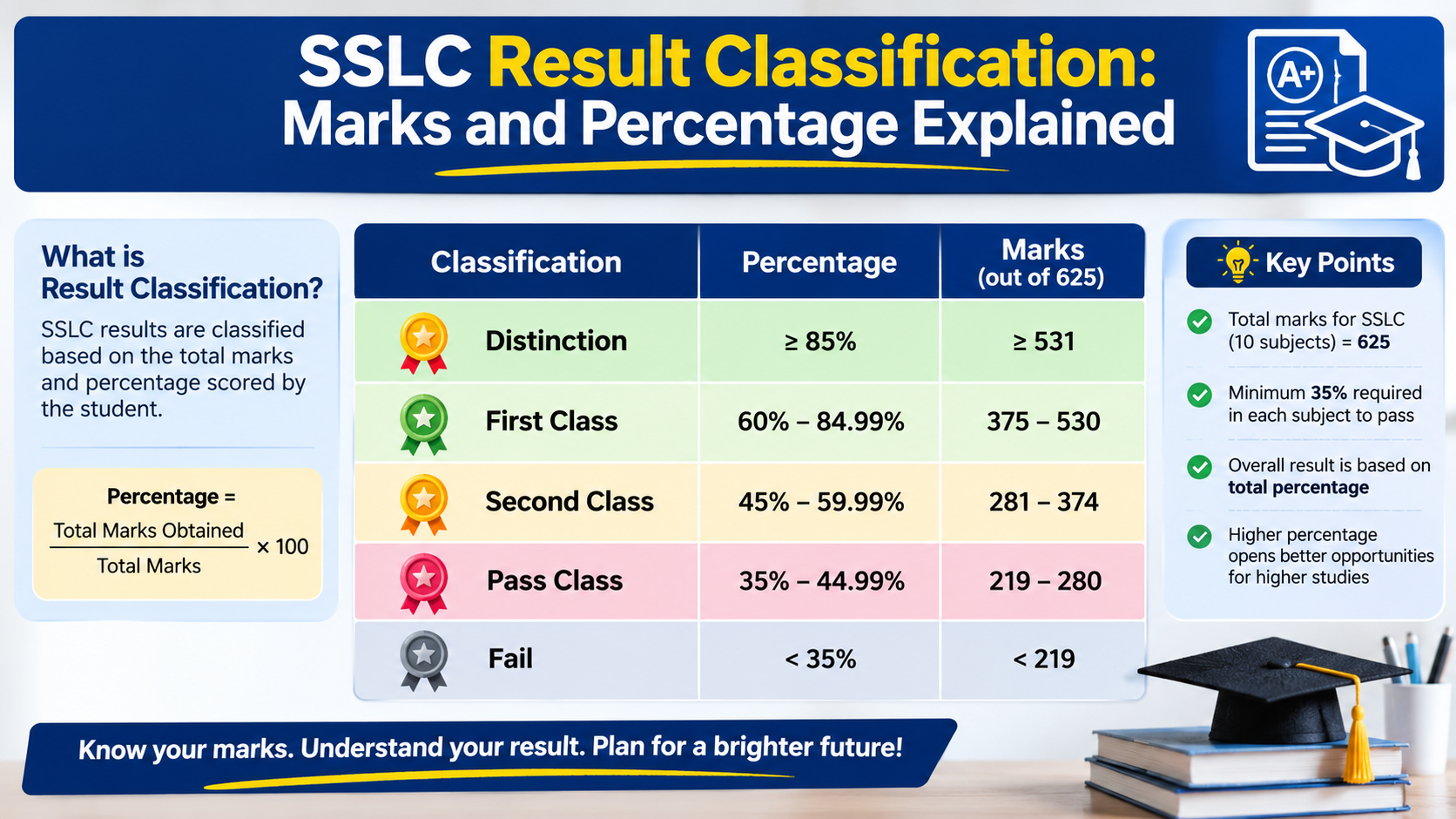
An SSLC result can look very different from the marks-based scorecards many students expect. In several state-board systems, especially Kerala’s SSLC system, the result displays subject-wise grades rather than a single total mark or overall percentage. Understanding this SSLC result classification is important when choosing higher-secondary courses, completing admission forms, or applying for a mark list.
The first rule is simple: do not assume that every Indian Class 10 board uses the same grades, pass rules, or percentage conversion. “SSLC” is a qualification name used by multiple state boards, not one national examination. Always treat the grade key and instructions on your own official certificate as the final authority.
Key Takeaways
- SSLC grading rules differ by state board; there is no universal India-wide SSLC grade-to-percentage chart.
- Kerala SSLC results are published with subject-wise grades on the official KITE result portal.
- In the Kerala grade scale used for admissions, A+ corresponds to 90% and above, while A corresponds to 80% and above.
- A grade indicates a range, not an exact mark; a percentage cannot be derived precisely from grades alone.
- Grade points may be used for admissions, but institutions can apply their own published calculation method.
- Use an official mark list or the admission authority’s prescribed conversion method when an application asks for exact marks or percentage.
What SSLC Result Classification Means
SSLC stands for Secondary School Leaving Certificate, generally awarded after Class 10 by state education boards in India. The result classification tells you how the board records your academic performance. Depending on the board, this may include:
- Subject-wise marks
- Letter grades
- Grade points
- A pass/eligibility status
- Total marks or percentage
- Internal-assessment and written-examination components
A marks-based result gives a numerical score, such as 78 out of 100. A grade-based result places that score within a performance band, such as A or B+. Grade-based reporting can make results easier to read, but it also means the exact mark may not appear on the certificate.
For example, two students who both receive an A grade may have different marks within the A-grade band. Therefore, they should not state the same exact percentage unless their official mark list or the relevant authority provides it.
Kerala SSLC Grades: The Common Reference Scale
Kerala’s SSLC result portal presents grades subject by subject. The official Kerala SSLC result service is operated through Kerala Infrastructure and Technology for Education (KITE) for the Government of Kerala.
For admission-related calculations, a Government of Kerala prospectus uses the following nine-point mapping for SSLC/THSLC grades and percentages:
| Grade | Percentage band | Grade point |
|---|---|---|
| A+ | 90% and above | 9 |
| A | 80% to below 90% | 8 |
| B+ | 70% to below 80% | 7 |
| B | 60% to below 70% | 6 |
| C+ | 50% to below 60% | 5 |
| C | 40% to below 50% | 4 |
| D+ | 30% to below 40% | 3 |
This mapping appears in the Government of Kerala’s admission prospectus, which also explains that the grade-point total can be used to calculate an admission index.
What A+ Really Means
A+ means the score is at least 90% in the relevant paper or subject component. It does not mean that the student scored 100%.
Similarly:
- An A indicates a score from 80% up to, but not including, 90%.
- A B+ indicates a score from 70% up to, but not including, 80%.
- A D+ represents the 30% to below-40% band in the cited grade-point conversion.
The grade on your certificate should be read as a performance band. It is not a substitute for a detailed mark statement where exact numerical marks are required.
Marks, Grades and Percentage: The Important Difference
These three terms are related, but they are not interchangeable.
Marks
Marks are the actual numerical score awarded in a subject or examination.
Example: 84 marks out of 100.
Percentage
Percentage standardises marks against the maximum possible marks:
Percentage = (Marks obtained ÷ Maximum marks) × 100
If a student scores 84 out of 100, the percentage is 84%.
If the total is 438 out of 500:
(438 ÷ 500) × 100 = 87.6%
Grade
A grade places marks into a defined range. In the Kerala mapping, 84% falls within the A band, but the grade alone does not reveal whether the score was 80%, 84%, or 89%.
This is why a student with only a grade certificate should not invent an exact overall percentage. A grade may establish a minimum threshold, but it does not disclose the exact score within that range.
Can You Convert SSLC Grades Into an Exact Percentage?
Usually, no—not from grades alone.
Suppose a student has an A in Mathematics. The grade establishes that the score is within the applicable A band, but it cannot identify the exact mark. A grade-only certificate therefore supports a range, not a precise percentage.
For example:
| Grade shown | What can be stated safely |
|---|---|
| A+ | At least 90% in the relevant subject band |
| A | At least 80% and below 90% |
| B+ | At least 70% and below 80% |
| C | At least 40% and below 50% |
A “full A+” result means A+ in all listed subjects. It demonstrates excellent performance across those subjects, but it does not establish one exact aggregate percentage unless an authorised authority issues marks or a prescribed conversion method.
Avoid Midpoint Conversion Unless It Is Officially Required
Some admission systems may assign a representative value to each grade for a specific ranking formula. That is an administrative calculation, not the student’s actual examination percentage.
For example, a rule may convert grades into grade points to create an index score. It does not authorise applicants to write an assumed percentage on all forms. Follow the exact prospectus or application instructions for the institution concerned.
Understanding Grade Points and Grade-Point Averages
A grade point is a numerical value attached to a grade. In the Kerala admission mapping above, A+ carries 9 points, A carries 8, and so on through D+ at 3 points.
Where an authority asks for total grade points:
- Note the grade point for each relevant paper or subject.
- Add those grade points.
- Divide only if the authority asks for an average.
- Apply subject weightage only when the prospectus explicitly requires it.
Illustrative Grade-Point Calculation
Assume an applicant has grades worth these points across 10 papers:
9 + 9 + 8 + 8 + 8 + 7 + 7 + 7 + 6 + 6 = 75
The total grade points are 75.
If the relevant authority asks for an unweighted average across 10 papers:
75 ÷ 10 = 7.5
This is an illustration only. Admissions may use specific subjects, weighted papers, bonus points, or other criteria. Kerala’s official HSCAP WGPA calculator asks applicants for total papers and total grade points in accordance with the applicable prospectus. Use that process rather than a generic online calculator.
How to Read Your SSLC Result Correctly
When your result is available, review it in a structured way.
1. Use the Official Result Portal
Access the portal named by your board. For Kerala SSLC, use the official KITE results portal. It asks for the student’s register number and date of birth.
Do not rely on screenshots, forwarded messages, or unofficial result websites for admissions or document verification.
2. Check Every Subject Separately
Look for:
- Subject name
- Grade or marks
- Register number and candidate details
- Result or eligibility status
- Any withheld-result notice or other remark
A strong overall profile should not prevent you from noticing a lower grade in a subject that matters for your planned stream or course.
3. Treat the Online Result as Provisional Information
Official result sites commonly state that online results are for immediate information and are not the original mark sheet. The Kerala result page identifies its output as an electronic copy, while the Board issues the original document separately.
Keep a printed or saved copy for reference, but use the original certificate, mark list, or an officially accepted digital record whenever an institution requires formal proof.
4. Keep Documents Ready
For Class 11, diploma, ITI, scholarship, or other applications, keep these available:
- SSLC certificate or grade sheet
- Official mark list, if issued or required
- Date-of-birth proof
- Transfer certificate, where applicable
- Category, disability, income, or residence documents if the scheme asks for them
How SSLC Grades Matter for Admissions
SSLC grades can affect course eligibility and merit calculations, but their importance varies by programme.
For higher-secondary admission, a school or centralised admission system may calculate a grade-point average or weighted score. For vocational programmes, subject-specific grades can matter more than the overall profile. A science-oriented programme may give weight to Mathematics and Science-related papers, while another programme may use a different rule.
Before entering any figure in an application:
- Read the current official prospectus.
- Check whether it asks for marks, grades, grade points, or a board-specific index.
- Use the stated conversion method only.
- Retain copies of the certificate and calculation, if the portal permits uploads.
- Contact the admission authority if the form does not accommodate your board’s result format.
Do not replace a requested mark with a guessed percentage. A wrong declaration can create problems during document verification even when the original result is valid.
Why SSLC Grades Are Not Uniform Across India
The abbreviation SSLC is used in more than one state context. Boards can differ in:
- Grade labels and boundaries
- Number of subjects or papers
- Internal-assessment treatment
- Passing and supplementary-exam rules
- Whether marks, grades, or both are printed
- Admission conversion formulas
Tamil Nadu, Karnataka, Kerala and other states administer their own examination systems and official result services. For instance, the Karnataka Examination Results portal identifies the Karnataka School Examination and Assessment Board, while Kerala SSLC results are published through the Kerala government’s designated services.
Do not apply a Kerala A+/A/B+ conversion table to a Karnataka, Tamil Nadu, CBSE, ICSE, or other board certificate unless the receiving institution explicitly instructs you to do so.
When You Need Exact SSLC Marks
You may need exact marks rather than grades for:
- Recruitment applications
- Overseas education or credential evaluation
- Certain scholarships
- Private-college admission forms
- Course applications requesting an aggregate percentage
- Document verification where a grade-only certificate is insufficient
For Kerala candidates, Pareeksha Bhavan’s e-services portal provides services relating to SSLC, THSLC and AHSLC mark lists. The portal sets out application requirements and fees; check it directly before applying because official procedures can change.
Use only an officially issued mark list, transcript, or authority-prescribed conversion. If the receiving organisation accepts grades, enter the grades exactly as shown on the certificate.
Frequently Asked Questions
Is A+ equal to 100% in SSLC?
No. In the Kerala admission grade scale, A+ means 90% and above. It indicates a band, not an exact score of 100%.
Can I calculate my overall SSLC percentage from subject grades?
Not exactly, unless your board or receiving institution provides an official conversion method. Grades show ranges, so the actual marks within each band are unknown.
What is the grade point for A+ in Kerala SSLC?
For the Kerala grade-point conversion used in the cited government admission prospectus, A+ carries 9 grade points.
Is a full A+ result the same as a 90% overall score?
A full A+ result shows that the student obtained A+ in every listed subject. It supports the conclusion that each relevant subject met the A+ threshold, but it does not by itself disclose one exact aggregate percentage.
Which SSLC document should I use for admission?
Use the document specified in the current admission notification. This may be the original certificate, official mark list, grade sheet, or a board-approved digital record. If exact marks are requested, provide an official mark document rather than estimating from grades.
Conclusion
SSLC result classification is best understood as a board-specific record of subject performance. In Kerala’s grade-based framework, A+ through D+ correspond to defined percentage bands and grade points, but a grade alone does not reveal an exact mark or aggregate percentage. Read your own certificate carefully, use official portals and prospectuses, and obtain an official mark list whenever an application requires exact numerical marks.


